Cove and Visitt competitive analysis
*AI-generated recommendations for discussion. These are not Nick’s recommendations or approved JLL/PRISM guidance.
Executive assessment
Cove and Visitt are converging on the same buyer: a commercial real estate operator who wants building operations, tenant services and portfolio oversight in one platform. Both cover work orders, maintenance, tenant apps, amenities, visitors and compliance. Describing Cove as only a tenant-experience app, or Visitt as only a maintenance system, would misrepresent their current products. [1] [2]
Visitt has the stronger public case for proactive work-order intelligence and multilingual operational communication. Its documentation shows similarity detection, generated titles and categories, and AI-assisted messaging. Its COI workflow extends from interpreting insurance requirements to validation and renewal reminders, with explicit human review in the documented tenant flow. This supports a broader automation proposition, but does not establish unattended case completion or error rates. [15] [24] [65] [66]
Cove has the stronger public case for a configurable, branded building experience backed by close implementation support. Its evidence is particularly persuasive around combining amenities, access, communications and operations across complex properties. It also has meaningful operational AI and rapidly evolving reporting; these are no longer plausible blanket gaps. [30] [32] [33]
For product strategy, the most attractive opening is reliable execution across fragmented operational data, with results measured at the workflow level. A new entrant should prove that an issue was classified correctly, assigned with sufficient context, resolved, and reconciled into the right downstream records. A generic chatbot, COI extractor or branded tenant app offers limited differentiation. Facilio, Jones, VTS and other competitors already occupy much of this territory. [55] [58] [59]
Review evidence makes the operational basics more urgent: recent feedback identifies portfolio administration in Cove, engineer adoption in Visitt, and a Visitt tenant-photo upload issue. Historical mobile complaints in both products warrant current-version tests, while newer releases and positive reviews limit claims of continuing defects. [70] [67] [75] [78]
The assessment is current to September 13, 2026. “Documented” means a vendor describes an operational workflow; it does not mean the workflow was tested in a live customer account. The accompanying gallery distinguishes help-center screenshots, older training-video frames, release illustrations and marketing mockups. Recommendations are analytical judgments; unverified capability gaps are identified explicitly.
Company, buyer and commercial context
| Dimension | Cove | Visitt |
|---|---|---|
| Product center of gravity | Unified building operating system; branded tenant experience and portfolio consolidation | Unified property operations; AI-assisted service delivery and workflow automation |
| Primary users | Property managers, engineers, tenant administrators, occupants and front-desk teams | Property managers, engineers, technicians, tenant-service teams, vendors and occupants |
| Most persuasive fit | Complex office, mixed-use and life-science properties with fragmented tenant-facing tools | Multi-property operations with high service volume, multilingual teams and pressure to standardize processes |
| Relationship to ERP | Operational and experience layer integrated with accounting and other systems | Operational layer integrated with Yardi, MRI and other systems; not a substitute for their full financial functions |
| Public commercial model | Demo and custom quote | Demo and contact-vendor pricing |
| Buying criterion to validate | Exactly which modules, integrations and services are included | Exactly which AI features, integrations and rollout services are included |
These are relative buying-fit judgments, not exclusive segments. Both support broader property portfolios. Neither company publishes enough comparable pricing detail to determine a price winner. Compare total subscription, implementation, data migration, access hardware, custom integration, support and AI usage costs on the same scope. A customer's consolidation savings should not be mistaken for the vendor's subscription price. [1] [7] [23] [43] [63]
Cove's current home page claims more than one billion square feet, while older material gives smaller figures. Its February 2026 update discusses a $72 million investment led by Lead Edge Capital in 2025. These establish scale and investment intent, not audited revenue, profitability or comparable market share. [1] [39] [40]
Visitt announced a $22 million Series B in January 2026, led by Susquehanna Growth Equity; an investor announcement describes more than 150 customers and substantial managed-square-footage growth during 2025. BGO's own June 3 announcement is stronger buyer evidence: a rollout had begun across a planned 46 million square feet and more than 300 properties. It does not establish that every property was live by September. [41] [38]
Company names require care. This analysis concerns Cove at cove.is, not unrelated companies using Cove or Cove AI branding. Search results for collaboration software, housing operators and other similarly named businesses were excluded.
Capability comparison
The matrix describes the strongest public evidence, not a numerical product score. Documented indicates help-center instructions; marketed indicates a product claim; unresolved means no sufficiently specific evidence was established. A missing public example is not proof of a missing feature.
| Workflow | Cove | Visitt | Competitive implication |
|---|---|---|---|
| Work-order intake and execution | Web/mobile requests, assignment, labor, materials and attachments. [4] [11] | Chat-oriented requests connected to operational records. [19] | Core parity; compare task completion with real roles. |
| Generated request titles/categories | Comparable automatic intake categorization was not established. | Explicit title generation and opt-in smart categories. [15] | Visitt has clearer evidence for reducing intake effort. |
| Duplicate and recurring issue detection | Specific equivalent was not established. | Similarity popup and Discovery report documented. [15] | A credible Visitt advantage, subject to matching accuracy. |
| Routing and overdue escalation | Issue types, work groups and automatic assignment/routing documented. 83 | Configurable trigger-condition-action rules. 16 | Automation exists in both; compare precedence, exceptions and the AI/rules boundary. |
| Work-order summarization | AI summaries marketed. [3] | Titles, communication assistance and operational insights are explicit. [14] [15] | Do not equate a short title with a full service-history summary. |
| Engineer writing assistance | Mobile note rewriting documented. [11] | Chat rephrasing documented. [15] | Broad parity in assisted writing. |
| Multilingual work-order communication | Automatic in-context translation was not established. | Live Translate, original-text access and terminology context marketed as available. [24] | Visitt has a specific, valuable frontline proposition. |
| Scheduled maintenance and inspections | Core modules, equipment context and mobile execution. [4] [12] | Core modules; inspection findings can become work orders. [20] | Depth, setup effort and adoption matter more than checkboxes. |
| Predicting equipment failure | No validated predictive benchmark found. | Prediction and early-warning claims; no validated benchmark found. [20] | Do not award demonstrated predictive superiority. |
| COI document extraction | AI review queue and human-reviewed extraction documented. [8] | AI extraction, validation and human confirmation documented. [65] | Both compete here; extraction alone is not differentiation. |
| Lease-to-insurance requirements | Equivalent automated lease interpretation was not established. | PDF-derived requirements, property defaults and tenant overrides documented. [65] [66] | Visitt has clearer evidence of requirements setup automation. |
| COI follow-up and exceptions | Human review and correction are explicit. [8] | Automatic reminders; the renewal guide retains an owner upload step. [66] | Compare complete case handling, including email replies and amendments. |
| General lease abstraction | Full financial lease abstraction was not established. | Specific live evidence is insurance requirements, despite broader lease-content marketing. [64] | Neither should be assumed to replace a full lease-administration suite. |
| Property knowledge assistant | Staff/tenant answers and visibility controls marketed; release image labels assistant Beta. [3] [13] | Ask Visitt marketed for operational questions. [14] | Different contexts; retrieval quality and permissions remain untested. |
| Dashboards and portfolio reporting | Current configurable Boards/Cards and multiple datasets documented. [10] | Reports plus reusable filtered Views documented. [17] [18] | Both are credible; natural-language analysis needs separate validation. |
| Tenant branding and content | Branded app, events, communications and building resources. 5 | Current Visitt+ guides cover home, requests, amenities, visitors, inbox and property switching. 85 | Both support broad tenant journeys; compare current configurations and usability. |
| Amenities and reservations | Multi-date creation documented; each date remains separately managed. [81] | Booking rules, billable slots, divided spaces and reservation chat marketed. [22] | Test series changes, role/device limits and billing exceptions. |
| Visitors and access | Preregistration, check-in, credentials and watchlists marketed. [6] | Visitor passes, access integrations and tenant-managed watchlists marketed. [14] [22] | Watchlists are not a Visitt-only feature. |
| Tenant satisfaction | Experience and engagement reporting; exact post-service instruments require comparison. [5] [10] | Post-service ratings, drill-down and tenant reporting documented. [18] | Distinguish app engagement from service satisfaction. |
| Billing and ERP | Accounting integrations plus mobile billable labor detail. 7 11 | Charge review, approval, accounting queues and errors; Verify Only differs from Verify for Sync. 84 | Queues and approvals are not exclusive differentiation; test omissions, correction effort and verified downstream state. |
| Integration openness | Ecosystem across access, payments, occupancy, parking and amenities; API/webhooks on home page. [1] [7] | GraphQL API, webhooks and named integration behaviors. [23] | A logo list is weaker evidence than tested field-level sync. |
| AI governance | Public FAQ explains provider use, limited data sharing and no client-data training. [9] | SOC 2 statement and workflow permissions; feature-specific security claims. [24] [42] | Ask both for current contracts and action-level audit evidence. |
AI workflow depth and maturity
Work-order intelligence
Visitt's distinguishing interaction is an alert attached to the operational record. The 2024 guide shows related requests, the matching category and property context, with a path to a Discovery report. The older guide limits matching to the same reporter; the current marketing illustration describes broader portfolio patterns. That expansion should be demonstrated with different reporters and similar-but-unrelated faults before treating it as proven. [15] [14]
The separate automation guide exposes the control model: triggers such as unviewed or incomplete work orders, filters such as category or building, then assignment or notification actions. It also documents non-retroactive rules, assignment precedence and protection against overwriting existing assignees. These details matter because errors can arise from configuration even when an AI classifier is correct. [16]
Cove's summary and content tools can reduce reading and drafting effort, but that is a different benefit from recognizing a persistent underlying fault. Its mobile redesign nevertheless contains a useful foundation: consolidated work logs, labor and material capture, status changes and missing-completion indicators. That operational record can support future intelligence if teams actually maintain it. [3] [11]
Product judgment: the defensible layer is not generation of a title. It is maintaining an accurate issue history across people, assets and buildings, then using it to choose and verify an appropriate intervention. A system that merely merges similar language can hide separate problems; one that never links recurring symptoms leaves repeated failures invisible.
COI automation
Cove's current documentation makes its boundaries unusually concrete: ACORD 25 is the preferred format, custom policy questions still require manual entry, aliases are saved per property, and the intake queue does not automatically refresh. Reviewers compare the document and extracted fields before approval. This is evidence of an assistive workflow with visible correction points. [8]
Visitt's tenant guide documents property-wide requirements with tenant overrides, AI extraction from PDFs and reviewer confirmation. Extraction works best with PDFs under two pages. Without saved requirements, automatic validation does not run. Updating requirements offers revalidation or retention of the existing COI status; revalidation produces Pending status for human review. The upload flow ends with the reviewer selecting Mark as Compliant. [65]
The broader COI guide documents required-versus-received comparisons, manual acceptance of discrepancies and automated renewal reminders. A tenant or vendor can reply by email with a replacement certificate; the documented next step is for the COI owner to upload it into Visitt. This is a concrete handoff to evaluate against the “autonomous agents” positioning, not proof that every deployment lacks another ingestion option. The guide also documents portfolio COI reporting and vendor policy categories. Its Hebrew version was inspected and paraphrased here. [66] [25]
The lease-abstraction article's specific live example is extracting insurance requirements for COI processing. Broader examples involving financial terms and critical dates should not be promoted into verified product scope without additional evidence. [64]
Product judgment: measure the fraction of a complete compliance case resolved without correction, including chasing missing documents, matching the correct entity and applying the correct requirements. An impressive extraction percentage can coexist with substantial manual work. Insurance interpretation and acceptance remain materially different from populating fields.
Communication and knowledge
Live Translate is a more differentiated frontline use case than generic copy polishing. Visitt describes retaining original messages, labeling translations and applying company terminology, with availability for all customers. Its published adoption and time-saving numbers lack enough cohort and measurement detail to treat them as a guaranteed return. [24]
Cove's tenant-oriented AI includes communications drafting and building-information answers. The release screenshot shows Property Assistant as Beta, while a different mobile article calls a site AI summary “coming soon.” These are distinct surfaces, so neither should be generalized into universal availability. Cove's March article also describes image generation for communications, which is a content-production feature rather than operational reasoning. [3] [12] [13] [62]
Product judgment: permission-aware answers must handle conflicting property rules, outdated documents and unanswered questions. Evaluate whether an answer cites the applicable record, identifies its effective date and declines to invent missing policy. Translation should preserve the original record and distinguish a suggested rewrite from a technician's actual observation.
Analytics, prediction and trust
Cove's new Insights documentation describes configurable charts and metrics across operational and engagement datasets. Visitt's current Views guide describes saved filters, sharing and export; its separate Reports guide includes SLA, inspection, similarity and tenant-service analysis. These are useful capabilities without requiring a conversational interface. The marketing promise of asking a portfolio question is a separate layer that still needs live validation. [10] [17] [18]
No reviewed evidence supplies a comparable, independently validated benchmark for prediction lead time, failure-detection precision, false alarms or avoided maintenance cost. Visitt's preventive-maintenance page markets such benefits, but recurring-ticket detection and scheduled maintenance should not be conflated with predicting a physical failure. [20]
Cove's FAQ explicitly describes third-party APIs, data minimization and restrictions on training. Visitt states SOC 2 Type II compliance; its translation article makes more specific data-containment claims. These disclosures are useful, but they do not establish model accuracy, account-specific contract terms or the quality of every deployed control. [9] [42] [24]
UI and interaction analysis
The gallery contains source images and selected video frames, not reconstructed interfaces. Help-center assets are closer to operating workflows than marketing illustrations, but can still be dated, staged or annotated. There was no authenticated hands-on session, so speed, accessibility, reliability and discoverability cannot be scored from screenshots alone.
Cove: broad navigation, explicit review and progressive detail
The COI intake screenshot shows a dense table with a persistent module sidebar. Status and matching information are visible across many documents. The review screen places the source certificate alongside extracted fields, which is a strong pattern for accountable document work: evidence and correction stay adjacent. The tradeoff is the density of exceptions and fields a reviewer must understand. [8]
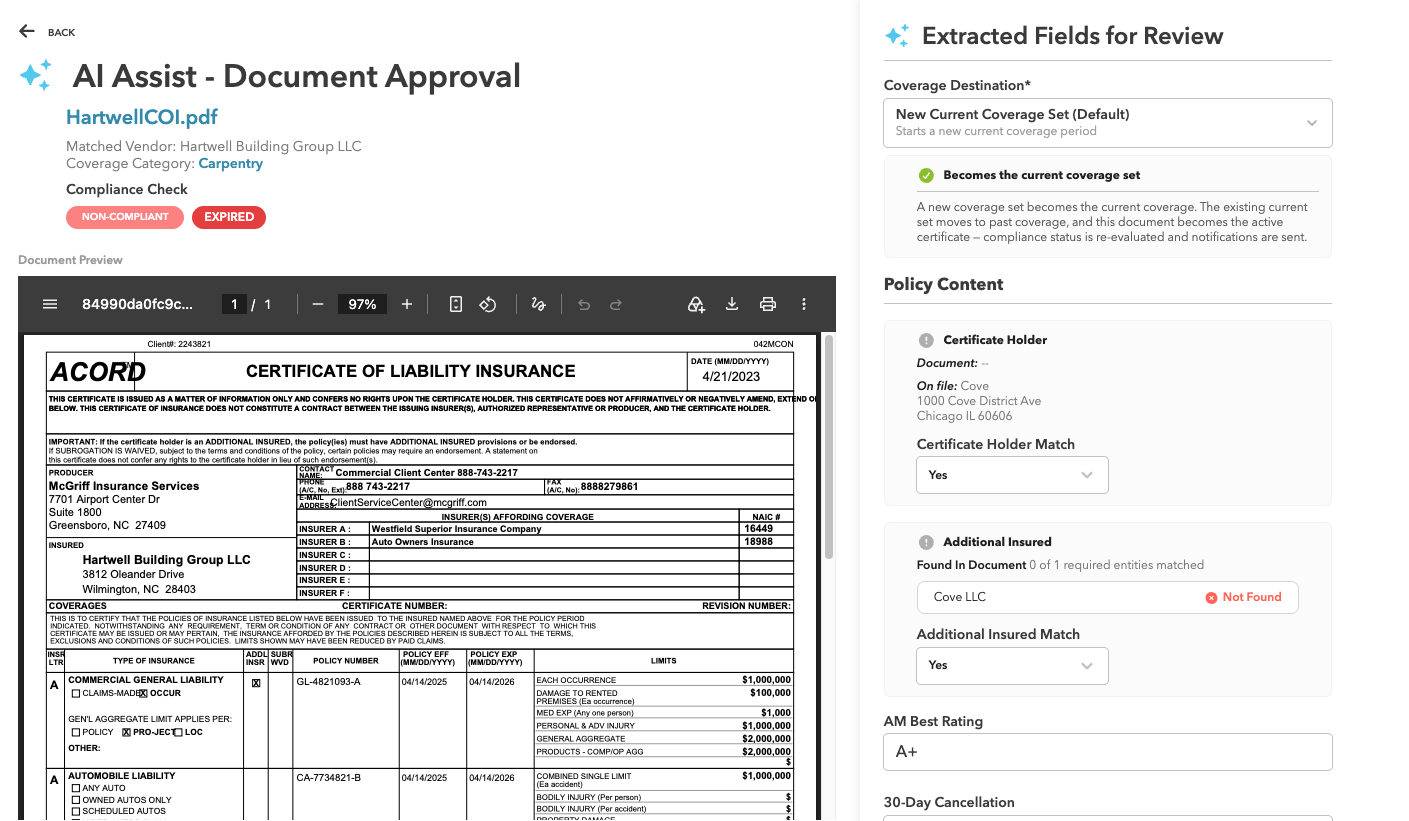
Figure 1. Cove help-center image: document and extracted fields side by side. This is documentation evidence, not a live accuracy test. [8]
The Insights screen uses conventional charts, while the configuration details expose metrics, time windows and breakdowns. This supports reusable operational reporting. The strategic UX question is whether a busy manager can get from an unusual metric to the responsible record and action quickly, without becoming a dashboard author. [10]
The mobile work-order images show information grouped into a Work Log, with labor, notes, materials and attachments close to execution controls. This is a practical data-completeness design. Required fields can improve billing and analysis, but excessive requirements can also encourage low-quality entries; usability testing should examine actual note quality and time in the field. [11]
Older tenant-training videos show a branded home feed, room-booking cards, calendars, visitor lists and side-panel forms on desktop. They reveal meaningful breadth across tenant and administrator roles, but should not be used to claim the exact current layout or click count. [44] [45] [46] [47]
Visitt: conversational intake, contextual intelligence and reusable lists
The help-center similarity popup makes the reason for an alert visible through related requests and shared context. This is more useful than a generic risk badge because the operator can investigate the underlying records. It still leaves open whether the system explains uncertainty and makes erroneous associations easy to correct. [15]
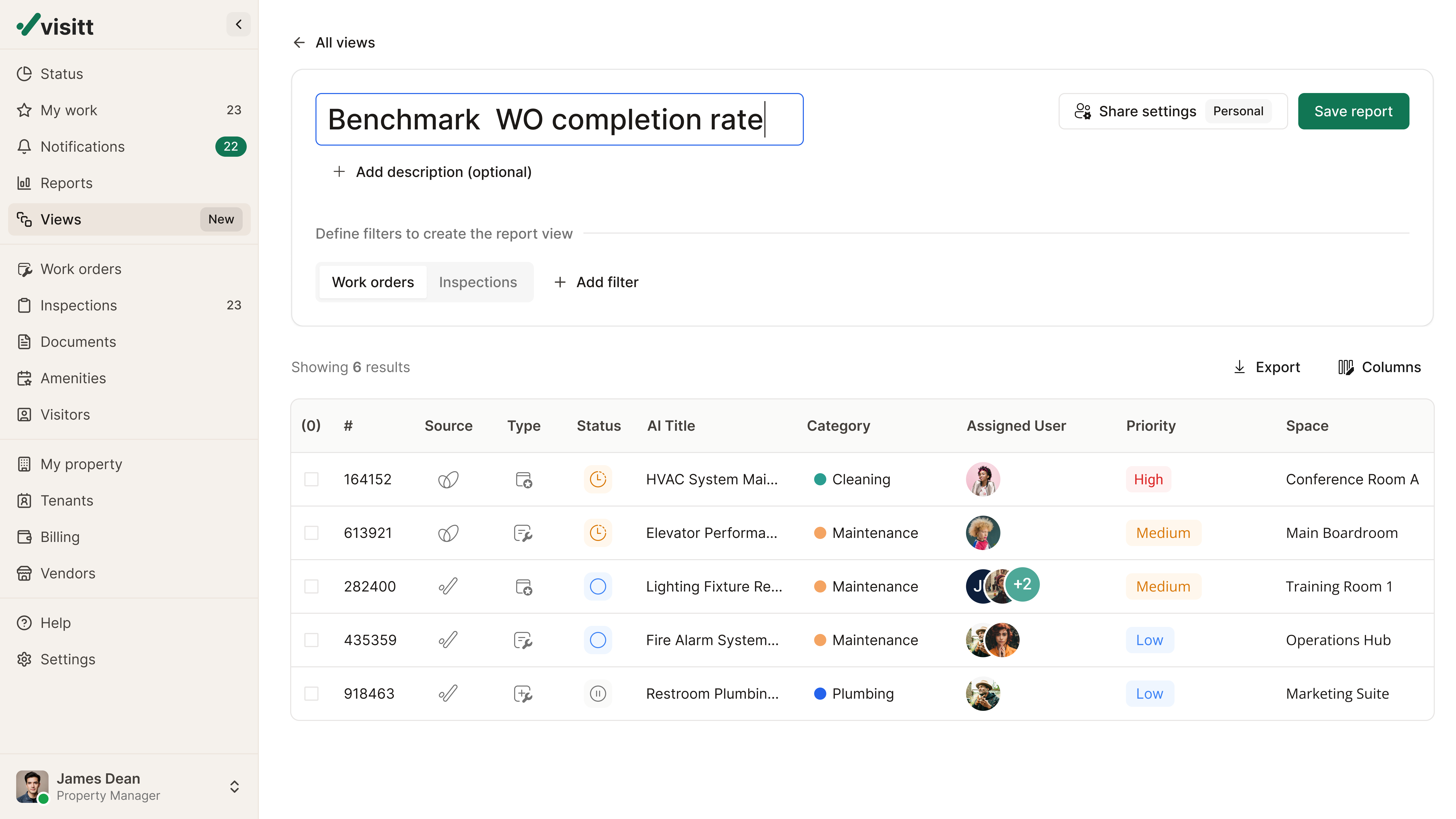
Figure 2. Visitt help-center image: a reusable filtered work-order view, including AI title, category, assignee, priority and space. It demonstrates a list-building interface, not the accuracy of natural-language analytics. [17]
The automation images use recognizable “when/then” controls and show the configured rules. That makes routing inspectable by an administrator. A stronger experience would additionally show a plain-language explanation of which rule and classifier result caused a specific action, particularly when several rules overlap. [16]
The COI screenshots add a structured requirements editor, tracking controls, document-review panel and renewal settings. Compare whether operators can see the applicable requirement version when accepting a discrepancy; the images alone do not resolve that question. [65] [66]
The Views screenshot presents a light sidebar, compact operational table and explicit sharing controls. Visitt's tenant page separately describes a chat-based request and reservation experience. This suggests an attempt to reduce form friction at intake while preserving structured records for operators. Whether the categorization is correct is an empirical question. [17] [22]
Patterns worth borrowing, and patterns worth testing
| Pattern | Visible example | Strategic lesson |
|---|---|---|
| Source beside interpretation | Cove COI review | Make correction possible without switching context. |
| Intelligence beside the task | Visitt similarity popup | Put findings where the operator can act. |
| Required completion evidence | Cove mobile work log | Improve record quality while measuring field burden. |
| Explicit action rules | Visitt automation setup | Let administrators inspect and explain automation. |
| Reusable analysis | Cove Boards and Visitt Views | Preserve useful questions and filters for the team. |
| Connected tenant and operator surfaces | Both vendors' public flows | Carry context across roles instead of re-entering it. |
These are design observations from Figures 1-2 and the cited documentation, not exclusive inventions. The most important untested interactions are exception recovery, wrong-record correction, cross-property switching, offline recovery, complex bookings and the transition from an insight to verified completion.
Why customers choose and keep each product
Cove customer evidence
Cove's recurring value proposition is one adaptable system plus a responsive team. Longfellow describes moving from eight to ten providers to one across roughly ten million square feet, introducing amenities before maintenance and work orders. That sequence is strategically interesting: tenant value created a reason to adopt the platform before broader operational standardization. [32]
At South Coast Plaza, the story centers on four buildings with different branding requirements, automated waivers, reservations and more than 500 monthly work orders. Samuels & Associates emphasizes launch support and day-one tenant adoption at a new building. Willis Tower demonstrates events and branded experience at a prominent address, but its cumulative user/event counts lack a measurement window. [33] [30] [29]
Boyle's case is a useful displacement example: an existing operations tool was acceptable, yet Cove's broader consolidation and standardization were persuasive. The implication is that winning does not require proving the incumbent unusable; it requires reducing the cost of the gaps between otherwise functional tools. [31]
Software Advice shows 4.3/5 from seven reviews. The visible 2025-2026 feedback praises support, onboarding and consolidated functionality. Criticisms concern reservations, Yardi sync depth, engagement analysis and portfolio administration. Current multi-date booking documentation partly supersedes the older entry complaint. These are individual experiences, not prevalence estimates or verified current defects. [27] [70] [81]
Visitt customer evidence
Visitt's strongest story is faster service with less coordination and clearer accountability. Carr's case reports 58% of work orders resolved within an hour and 82% within three hours. It also describes custom integrations, including reducing a utility-bill process from eight hours to under one. These figures are customer-story claims; the latter is an integration-specific result, not a default feature guarantee. [34]
Related Ross reports a two-month onboarding period, threefold tenant engagement and a 4.9/5 service score. Its use alongside Related360 shows that coexistence can be a winning model, even for a vendor positioned as an all-in-one platform. [35]
Epic supplies the most useful balanced evidence. Visitt's case describes a 12-million-square-foot, 170-plus-building deployment in 60 days and higher recorded participation. Nexus Labs' account of the customer presentation describes a median response-time reduction from 36 to 10 minutes, while also reporting slower adoption of preventive maintenance and inspections. Equipment records, habits and operating standards remained obstacles. Higher captured request volume should not be interpreted as more building failures. [36] [37]
Capterra shows 4.8/5 from nine reviews and very strong service feedback. Visible reviews praise usability, accountability and communication; an integration difficulty was described as resolved. The visible examples are from 2021-2022 and marked vendor-referred/incentivized. Their age prevents using them to validate the current COI agent, translation or newer analytics. [28]
G2 adds recent evidence: its newer seller listing shows 5.0/5 from seven reviews, including 2025-2026 feedback. Individual comments identify engineer adoption and space-creation discoverability as friction points. These update the customer picture, although they still do not measure AI accuracy or autonomous completion. [67] [68]
The historical YouTube customer interview reinforces the support theme: Jill Dunlap describes replacing duplicate online/Excel work, the importance of mobile use, and repeated on-site help. It is useful evidence about adoption needs, not proof of today's AI performance. [48]
What the evidence can and cannot support
Both vendors appear to win when users feel the product fits their building and someone helps them make it work. That conclusion is supported across multiple customer accounts, but the accounts are selected by vendors or review platforms. There is no representative churn dataset, renewal cohort, NPS series or win/loss study.
Do not combine software-directory reviews, G2 reviews, app-store ratings and tenant-service scores as if they measure the same population. Nor can faster response times be attributed entirely to AI when migration, training, workflow redesign and adoption changed at the same time. The strongest commercial lesson is to productize implementation and ongoing operating discipline alongside the software.
Review evidence and product gaps
The clearest review-based opportunity is to make routine work dependable across roles: a tenant can sign in and submit a complete request; an engineer can adopt the required workflow; a manager can coordinate several buildings without repeated administration. Buyers often praise both companies' implementation teams. End users report more friction with everyday mobile actions. These are different perspectives, not comparable satisfaction cohorts. [27] [67] [75] [76] [77] [78]
Platform coverage and interpretation
| Platform | Cove | Visitt | Interpretation |
|---|---|---|---|
| G2 | A matching cove.is review profile was not established; unrelated Cove products excluded. | Newer seller listing: 5.0/5, seven reviews. Older English product snapshot: six. [67] [68] | One changing review pool, not thirteen respondents. Recent invited reviews and an organic April 2026 review exist. |
| Capterra / Software Advice / GetApp | 4.3/5, seven reviews; 2025-2026 text. [27] [70] [71] | 4.8/5, nine reviews; accessible text mainly 2021-2022. [28] [72] [73] | Repeated text, dates and identities indicate overlapping pools. Do not multiply sample sizes across sites. |
| US Apple App Store | 3.3/5, 34 ratings; ten written entries inspected. [75] | Visitt+ Tenant App: 2.7/5, 12 ratings; four written entries inspected. [76] | Ratings exceed written comments; generic apps do not cover every branded deployment. |
| Google Play, US English | 2.8/5, 15 displayed reviews/ratings; seven English comments inspected. [77] | Live 2.9/5; header says 18, phone section 17; five English comments inspected. [78] | Store counts vary by snapshot and device view. Older Visitt indexed values were 2.5/5 and 16/15. |
| TrustRadius | No usable attributable review corpus established. | Product listing accessible, without customer-review text. [74] | A directory presence supplies no negative or positive customer evidence by itself. |
| Software Finder / other aggregators | No stronger attributable corpus established. | Three positive Software Finder entries; Zoftware claims 33 reviews behind summarized strengths/weaknesses. [79] [80] | Additional independent respondents and the basis for aggregated complaints were not established. |
The accompanying review ledger preserves selected attributable entries, dates, sentiment, limitations and a validation question. It is not a census or a count of unique customer organizations. Some G2 and Capterra material was available as indexed public text while live pages restricted access. Store observations were checked live on September 13, 2026. Rating averages are preserved as displayed rather than recomputed from incomplete visible comments.
Cove: specific workflow gaps
| Finding | Review evidence | Current status and product implication |
|---|---|---|
| Portfolio communication and vendor lookup | Brianna L., July 6, 2026, asks for announcements across properties and quick vendor contacts in the app. [70] | Recent, specific single-review signal. Test one message across selected properties and property-specific emergency vendor lookup. Do not infer the absence of all vendor management. |
| Reservation accounting continuity | Zulimar T., July 2025, wants reservation data to sync with Yardi as work orders do. [27] | Integration depth question, not evidence that Yardi integration is missing. Demonstrate charges, changes and reversals reaching the accounting record. |
| Multi-date reservation lifecycle | Tracie L., August 2025, reports separate daily entry. [70] | Partly superseded: current documentation allows multi-date creation, but dates remain separately managed. Focus on group changes, cancellation and reconciled charges. [81] |
| Tenant workflow clarity | An anonymous December 2025 reviewer seeks simpler reservation and work-order flows while praising reliability. [70] | Subjective usability signal; observe unfamiliar tenants completing these tasks. A redesigned appearance alone does not prove lower effort. |
| Engagement analysis | Gybson R., July 2025, wants tenant-level event-interest analysis. [27] | Insights and email delivery/open metrics now exist. Cross-event tenant analysis and activation requirements remain the relevant questions. [10] [82] |
| Mobile access and recovery | App-store entries describe crashes, login/setup obstacles and unreliable building entry; Android feedback also mentions persistent background activity. [75] [77] | Historical reports across several users, with later positive feedback and releases. Test the current login-to-access journey and recovery behavior; do not claim a present fleet-wide outage. |
Cove's booking documentation materially narrows the older complaint. Supported amenities allow multiple dates in one submission, with up to ten on the dashboard. Each date remains its own record, with separate notifications and later edits or cancellations. Paid-reservation changes also depend on role and device. This is a more defensible opportunity around managing a booking series than a claim that multi-date creation is unavailable. [81]
The email-metrics guide is less clear about rollout: its introduction says open rates are forthcoming, while a later section tells customers to request activation. A new entrant could compete on readily usable reporting and clear entitlement status, but should first test the exact tenant/event question. This is a documentation and activation issue; it is not proof that Cove lacks analytics. [82]
Visitt: adoption and tenant execution gaps
| Finding | Review evidence | Current status and product implication |
|---|---|---|
| Engineer adoption beyond basic use | A December 10, 2025 G2 reviewer struggles to get engineers to use the full feature set. [67] | Aligns with Epic's maintenance-adoption account. Test task-specific onboarding, supervisor visibility and continuing participation. [37] |
| Infrequent configuration tasks | Crystal L., January 7, 2026, sometimes forgets how to add a space. [67] | A narrow discoverability issue. Test successful setup without manager intervention; avoid labeling the whole platform difficult. |
| Photo submission reliability | Eric Ofoe, January 11, 2026, reports freezing when attaching a maintenance photo on Android. [78] | Concrete recent scenario, but it predates September's redesign. Test permission changes, large files, retries and preservation of the request. |
| Login and notification continuity | Older tenant reviews describe repeated verification, missing codes or notifications, and loading failures. [76] [78] | Historical recurring theme across mobile sources. Test end-to-end notification delivery and authentication recovery on the current app. |
| Scheduled ownership reporting | Niv B., December 2021, requests automatically emailed monthly reports. [67] | Old request. Current reporting/export is documented; scheduled delivery needs separate verification. [18] |
| Scheduling flexibility | An April 2026 review in G2's AI-translated edition asks for more time options. [69] | Low-confidence lead: the exact scheduling surface and limitation are unclear. Do not infer missing recurring reservations or custom durations. |
The live Visitt+ Android listing describes a September 2, 2026 redesign with simpler navigation and quicker request, amenity and visitor flows. That is meaningful counterevidence to blanket claims that older layouts remain unchanged. It does not independently demonstrate that the January photo-upload issue is fixed. Tenant-app reviews also must not be generalized into measurements of the separate property-operations application. [78]
Visitt's old software-directory evidence contains a more specific mobile complaint than its aggregate score suggests: Violetta I., December 2021, reports slowness and needing a browser. The vendor acknowledges feedback and promises mobile updates. Deanna's integration challenge was described as ultimately working, while Melissa praises smooth integration. These are implementation experiences with conflicting outcomes, not proof of a universal integration defect. [72]
Company and service gaps
Adoption is a continuing service obligation. Visitt's engineer-adoption complaint and Epic's rollout experience reinforce the need to measure actual participation after deployment. For either company, onboarding success should include a novice completing representative work and a manager spotting unused capabilities. A deployment that relies on a few knowledgeable champions is vulnerable when roles change. The last statement is a product hypothesis, not an observed churn result. [67] [37]
Manager satisfaction may conceal tenant friction. Cove's positive implementation reviews coexist with mobile complaints; Visitt's strong G2 communication feedback coexists with tenant-app difficulties. Support can be excellent for the paying operator while an occupant still cannot enter, authenticate or submit a photo. Evaluate support escalation by role, property and incident type. Do not use app-store complaints to claim that either company's entire support function is poor. [27] [67] [75] [76] [78]
Explain why the building app needs data and background activity. Cove's June 2026 Android privacy complaint is evidence of distrust, not a verified security incident. Combined with earlier objections to background behavior, it suggests clearer permission explanations, controls and fallback paths as a product opportunity. Keep this separate from an assessment of actual data handling or security. [77]
Priorities suggested by reviews
| Priority | Opportunity | Demonstration that would establish value |
|---|---|---|
| 1 | Dependable tenant actions and recoverable failures | Complete login, access, request submission with photo, and notification follow-up across poor connectivity and expired sessions; preserve user work. |
| 2 | Less repeated portfolio administration | Send one appropriately scoped announcement, locate the correct property's vendor, and manage a booking series without inconsistent records. |
| 3 | Adoption built into everyday work | A new engineer and an infrequent administrator complete their core tasks without a specialist guiding every step. |
| 4 | Reporting that answers a decision and reaches its audience | Trace a tenant/event question to supporting records, then verify correct recipients and timing for a scheduled owner report. |
These are evidence-informed validation priorities, not estimates of market prevalence. None of the inspected review cohorts provides a reliable benchmark for AI accuracy, autonomous COI completion, prediction quality or AI-driven renewal uplift. Recent G2 reviews improve Visitt's evidence for ordinary workflows; they do not independently validate its broad AI positioning.
Claims to exclude from competitive positioning
Do not claim that Cove has no multi-date booking, that Visitt has no recent reviews, or that either has no mobile app or analytics. Do not equate one feature rating with a reliable product ranking: GetApp's low integration scores use one respondent per product. Avoid aggregators' unattributed offline-sync allegations, automated scam scores and reviews of unrelated Cove products. The evidence supports narrower workflow tests and a distinction between what was reported, what changed, and what remains unverified. [71] [73] [80] [81]
Public messaging, social channels and video
Cove's public narrative emphasizes consolidation, recognizable properties and the partnership with operating teams. LinkedIn examples around Longfellow and BOMA translate that story into customer outcomes and practical demonstrations. Its communications are especially effective at making an abstract platform tangible through a building, an operator and a before/after workflow. [50] [51] [52]
Visitt's messaging is more assertive about AI: agents, a single interface, workflow outcomes and funding-led expansion. Its company feed pairs this with customer partnerships and product demonstrations. The distinction is one of emphasis, since both now make broad AI and unification claims. The current mention of a final COI human check is more operationally useful than unrestricted autonomy language. [53] [54]
The accessible Visitt YouTube material is relatively old. One customer interview offers useful implementation testimony; the short tenant-app promotional video's accessible transcript provides little substantive feature detail, and playback could not be inspected. Cove's help center, by contrast, links detailed tenant-admin training clips covering work orders, amenities and visitors. These clips were more useful for UI evidence than promotional footage. [44] [48] [49]
This is a qualitative analysis of accessible public content, not a complete social listening dataset. Follower counts, search visibility and enthusiastic employee or investor comments are not evidence of customer satisfaction or acquisition efficiency. LinkedIn was the richest accessible social source; comparable engagement and conversion data across social channels were unavailable.
Messaging opportunity: show one complete operational case, including the messy input, the correction, the approved action and the measured result. A repeatable, specific proof format can be more credible than broad claims about an AI-native platform.
Gaps between Cove and Visitt
A competitive gap can be a demonstrated limitation, a difference in documented capabilities, an evidence gap or a historical complaint. Keeping these categories separate prevents a strategy from depending on an obsolete or imaginary weakness.
Cove relative to Visitt
| Candidate gap | Evidence and confidence | Product consequence |
|---|---|---|
| Recurrence detection and automatic intake enrichment | Visitt's documented workflows are more explicit; equivalent Cove behavior not established. Medium confidence in relative evidence. [15] | Prioritize a direct test with messy requests and different reporters. |
| In-context multilingual communication | Visitt documents a specific translation experience; Cove equivalent unresolved. Medium confidence. [24] | A meaningful advantage where engineers, managers and tenants use different languages. |
| COI administration at portfolio scale | Cove documents property-specific aliases and manual custom fields; Visitt documents shared tenant requirements. These are different configuration layers. [8] [65] | Test repeated setup effort and cross-property portability; do not equate policy aliases with coverage requirements. |
| Complex reservations and downstream accounting | Multi-date creation now documented; separate record management remains. Reservation-to-Yardi depth still unverified. [27] [81] | Test series cancellation and accounting adjustment, not just initial creation. |
| Repeated portfolio administration | July 2026 review requests cross-property announcements and readily available vendor contacts. Single recent account. [70] | Test role permissions, cross-property scope and emergency contact retrieval. |
| Tenant engagement reporting | Insights and email metrics partly address older criticism; activation and exact cross-event analysis need validation. [10] [27] [82] | Validate the decision the manager needs to make, rather than an analytics checkbox. |
Visitt relative to Cove
| Candidate gap | Evidence and confidence | Product consequence |
|---|---|---|
| Breadth of demonstrated branded property operations | Cove has especially detailed mixed-tool and multi-brand implementation stories. Visitt also offers branding and amenities. Medium confidence in proof emphasis, not feature absence. [30] [33] [22] | Compete on specific tenant journeys and service delivery, not a branding checkbox. |
| Maintenance adoption after launch | Epic's experience and a December 2025 G2 comment both identify adoption friction. [37] [67] | Treat equipment readiness, standards and frontline behavior as product work. |
| Transparent proof of conversational analytics | Marketing exceeds what the saved-Views guide alone establishes. High confidence as a verification gap. [14] [17] | Show source-linked answers, scope, permissions and the resulting action. |
| Review evidence for new AI | Recent G2 comments exist, but do not measure the newer agents' accuracy or completion quality. [28] [67] [68] | Publish current independent references using the actual agent workflows. |
Shared gaps and unresolved questions
Visitt's documented renewal-upload handoff identifies a specific case-completion opportunity to test. Cove's corresponding email-ingestion behavior was not established. This is a workflow hypothesis, not a demonstrated Cove advantage. Compare attachment handling, amended requirements and the provenance of the resulting status in both products. [65] [66]
Neither company's reviewed public evidence provides a complete model-quality evaluation, audited time-saving methodology, comparable total pricing, a causal retention study, or an end-to-end exception-recovery benchmark. These are evidence limitations, not declarations that the products lack the underlying capabilities.
The most useful shared product questions concern dirty data, inconsistent equipment identities, workflow portability between properties, integration failures, role transitions and proof that a completed task solved the original problem. Customer stories and documentation make these important evaluation areas; they do not establish that every area is broken in both products.
Mobile reviews add authentication, notification and attachment recovery to that diligence list. Current releases must be tested: historical complaint recurrence is not a measured current failure rate. [75] [76] [77] [78]
Wider competitive landscape
| Competitor | Relevant public offering | Implication for this comparison |
|---|---|---|
| JLL Building Engines / Prism | Operations and Experience packages with Prism AI; extensions include HqO and Jones. [55] | The incumbent also markets unification and AI. Replacing “legacy software” is not sufficient positioning. |
| VTS Activate | Configurable work orders, maintenance, invoices and communications; a July 2026 SwiftConnect partnership expands access capabilities. [56] [57] | The overlap spans operations and experience. Mobile access alone is not unique. |
| Facilio | Atom assistants market work-completion validation, inspection-to-action processing, contractor updates, conversational actions and audit trails. [58] | Several attractive opportunities against Cove/Visitt already face a direct specialist competitor. |
| Jones | AI-assisted insurance compliance combined with expert review, collection, follow-up and audit records. [59] | COI competition is about depth and operational completion, not extraction speed alone. |
| HqO | Current positioning extends to a CRE experience CRM, intelligence and interconnected operating suites. [60] | Tenant relationships and portfolio intelligence are contested areas. |
| Equiem | Engagement, operations, flexible spaces, data and integrations. [61] | Another consolidation competitor; also an integration partner listed by Visitt. |
This is a targeted strategic perimeter, not a full evaluation of every competitor. The table is based on current vendor descriptions, so delivery depth still requires validation. Residential accounting suites and generic maintenance tools may appear in review-site alternatives, but are not automatically the closest substitutes for this enterprise CRE buying decision.
Prioritized product opportunities
These priorities assess a general market entrant. For PRISM, use the colleague strategy brief: test financial follow-through in a qualified segment, with operational readiness as the delivery foundation. Neither ordering establishes proven demand or exclusive capability.
1. Faster operational readiness
Recommendation: highest initial priority. Build a deployment and continuous-data-quality layer that reconciles equipment identities, identifies missing records, maps operating categories and tests integration completeness. Produce a visible readiness queue with an owner, the affected workflow and a clear resolution path. Begin with a small portfolio segment and one system of record.
The rationale is Epic's post-migration maintenance adoption difficulty, newer G2 adoption feedback and both vendors' emphasis on implementation support. The hypothesis is that operators will pay for a shorter, more reliable path from “software configured” to “team executing the required work.” This is not established demand; validate willingness to pay before treating it as a standalone category. [37] [67] [30]
Proof target: reduce time to the first reliable maintenance cycle, decrease unlinked asset records, and show that data corrections persist through the next synchronization. Measure support hours and field-team participation, not only imported row counts.
Competition and risk: incumbents can improve migration tooling, and customers may expect onboarding to be included. The product needs continuing value after launch through drift detection, new-property onboarding and integration health.
2. Verified recurring-issue resolution
Recommendation: high value, higher competitive difficulty. Connect repeated symptoms to asset history and prior actions; propose a next step with evidence; obtain the appropriate approval; then check whether the issue recurs. Preserve the distinction between an AI suggestion, an operator decision and an observed outcome.
The rationale is Visitt's demonstrated recurrence workflow and the wider market's movement toward completion validation. Facilio already markets closely related capabilities, so this is not greenfield whitespace. A viable entry requires a narrower asset class, fault type, integration advantage or measurable reliability advantage. [15] [58]
Initial scope hypothesis: recurring comfort complaints in a small set of office buildings, using work orders and existing equipment records. Avoid promising generalized failure prediction. Track expert-reviewed duplicate precision, time to a qualified response, reopened requests and recurrence after closure.
Stop condition: if the system cannot distinguish separate faults with similar language, or cannot preserve human corrections, do not expand autonomous action. The commercial value is fewer repeated problems, not more generated recommendations.
3. Evidence-led COI operations
Recommendation: promising narrow workflow, crowded market. Focus on consistent requirements, reusable policy mappings, explicit document provenance and an exception queue. A reviewer should see which source requirement caused a discrepancy and which step is waiting on a tenant, vendor, broker or manager.
Cove's property-specific mapping boundary suggests repeated administrative effort. Visitt already supports shared requirements, and Jones competes in broader compliance completion. A sharper hypothesis is reducing handoffs after returned documents and preserving an auditable relationship between requirement changes, review decisions and status. Require incumbent demonstrations before claiming either capability is absent. [8] [65] [66] [59]
Proof target: total human minutes per completed case, incorrect-entity matches, correction rate, aging exceptions and rework after amended requirements. Report review effort separately from elapsed waiting time. Do not claim legal adequacy from software status alone.
4. Tenant service context across the lifecycle
Recommendation: second-stage expansion. Combine service history, unresolved commitments, reservation friction and relationship context into a useful account view. Present evidence for a property manager's conversation with the tenant, rather than an unexplained churn score.
Both products already collect significant tenant interaction data; HqO and VTS also compete for this relationship layer. A narrow entry point could be identifying promises that remain unresolved across operational systems. Demonstrate that the manager can correct the context and distinguish a tenant company from an individual occupant. [18] [60] [56]
Proof target: fewer missed commitments and faster preparation for tenant meetings. Treat renewal impact as a longer-term hypothesis requiring a suitable comparison group, since rents, location, lease timing and business conditions can dominate software effects.
5. Transparent automation economics
Recommendation: make this a product property, not a standalone dashboard. Every workflow should show how many cases were completed, what humans changed, how long review took, and whether the task had to be reopened. Attach time-savings estimates to actual measured baselines and show uncertainty.
This directly addresses the public evidence gap: vendor-wide percentage claims are hard for an operator to translate into a staffing or procurement decision. An auditable measurement approach could strengthen any of the opportunities above. It must avoid counting generated drafts, duplicate alerts or attempted automations as completed value.
Suggested 90-day validation sequence
| Period | Work | Decision evidence |
|---|---|---|
| Days 1-15 | Interview portfolio operations, engineers, tenant-service teams and implementation staff; inspect recent difficult cases. | Rank recurring costs by frequency, severity and existing workaround. |
| Days 16-30 | Run the same realistic demo script with Cove, Visitt and the closest specialist. | Eliminate imagined gaps and identify one poorly served workflow. |
| Days 31-60 | Pilot a constrained solution in a few properties with a baseline period and named operators. | Measure adoption, error correction, elapsed time and human effort. |
| Days 61-90 | Test additional properties, policy differences and integration failures. | Decide whether gains survive variation and whether buyers will pay. |
The sequence assumes a product team considering a new capability or entry point; it is a recommendation, not a vendor implementation promise. Do not begin by replacing the entire operating system. Integration into the incumbent workflow can create a faster evidence path, although API terms and partner access must first be verified.
Demo and diligence script
Use identical input data and success criteria across vendors. The following are proposed tests, not reported product results.
| Test | Scenario | What to observe |
|---|---|---|
| Intake intelligence | Similar HVAC complaints from different tenants, plus an unrelated issue using similar words | Matching explanation, classification correction, separate-issue handling and routing |
| Multilingual handoff | A technician documents work in one language; manager and tenant use two others | Original preservation, terminology, translation labeling and tenant-visible permissions |
| Recurrence after closure | Reopen a complaint after a prior repair | History linkage, accountable owner and whether the prior “resolution” is reconsidered |
| COI exception | Wrong entity, missing endorsement, amended requirements and renewal email with attachment | Entity matching, attachment ingestion, revalidation choice, approval authority and status provenance |
| Cross-property policy | Apply a corrected insurance rule to several properties | Reuse, local overrides, effective dates and effect on already-approved documents |
| Portfolio question | Ask why service slowed for a tenant group | Exact record scope, cited evidence, date filters and reproducible calculation |
| Reservation edge case | Multi-day divided-room booking, cancellation, refund and changed tenant account | Calendar correctness, approvals and accounting reconciliation |
| Field completion | Partial connectivity, missing reading and required labor entry | Recovery, data preservation and whether quality checks add useful evidence |
| Integration recovery | A source-system record changes while a downstream sync is unavailable | Error visibility, replay, duplicate prevention and accountable reconciliation |
| Permissions and exit | A user changes roles; export records and attachments | Correct access changes and usable, complete data portability |
Ask for feature availability by plan, property type and region; current beta status; model/subprocessor disclosures; data-retention terms; integration field mappings; support ownership; implementation assumptions; and a complete written quote. Obtain references who use the specific AI workflows under consideration, not only longstanding customers of the core platform.
Evidence boundaries and interpretation
The strongest sources here are public product instructions, original customer announcements and specific customer accounts. Vendor case studies remain selected evidence; review directories have small samples and may syndicate the same respondents. Social posts establish messaging and announcements, not a representative view of customer sentiment.
Recent documentation supersedes older indexed content where it describes the same workflow. Cove's reporting release illustrates why historical review complaints need rechecking. Its August-titled article contains a September newsletter, and its assistant surfaces have different beta/roadmap labels. Visitt's older similarity guide has a narrower scope than current marketing, while saved Views documentation does not establish every AI analytics claim. These discrepancies are retained as evaluation questions rather than silently resolved. [10] [12] [13] [15] [17]
No revenue estimates, market-share ranking, engineering headcount inference or customer-retention prediction is presented. Claims about automated compliance, prediction, time saved and adoption retain their source limitations. The recommended opportunities are relative judgments based on the available evidence, with explicit competitive threats and validation criteria.
The source register preserves original URLs, publisher, available date, source type and notes. The gallery preserves provenance for each visual, including training timestamps. Files are designed for product planning and further diligence rather than a substitute for live trials or customer reference calls.
Sources
All sources accessed September 13, 2026. Dates below describe the source, not necessarily the release date of every feature.
- Cove. Unified Commercial Property Management Software. Undated; current page. Vendor product page
Current 1B+ SF claim; integrations, pricing CTA and portfolio positioning.
- Visitt. CRE Property Management & Operations Software. Undated; current page. Vendor product page
- Cove. AI Property Management Software. Undated; current page. Vendor product page
- Cove. Seamless Building Operations Software. Undated; current page. Vendor product page
- Cove. Centralized Tenant Experience Platform. Undated; current page. Vendor product page
Some scale copy still says 700M+ SF.
- Cove. Visitor Management Software. Undated; current page. Vendor product page
- Cove. Software Integrations. Undated; current page. Vendor product page
- Cove Knowledge Base. COI Extraction: AI Review. Current September 2026 revision. Product documentation
Current browser text supersedes older indexed AI Review: COI Extraction content.
- Cove Knowledge Base. CoveAI FAQ. Displayed updated 6 months ago. Product documentation
- Cove Knowledge Base / Andrea. Insights Dashboard. Displayed updated 11 days ago. Product documentation
- Cove Knowledge Base / Andrea. Guide to Work Orders on Mobile. Displayed updated 1 month ago. Product documentation
- Cove Knowledge Base. Mobile Engineer Experience. Displayed updated 3 months ago. Product documentation
Site AI summary explicitly described as coming soon.
- Cove Knowledge Base / Andrea. August 2026: AI-powered Insights, Streamlined Workflows. Displayed updated 10 days ago. Release note
Article title says August; embedded newsletter says September 2026. Assistant visible as Beta.
- Visitt. Visitt AI. Undated; current page. Vendor product page
Public animated illustrations and vendor claims; not an authenticated product test.
- Visitt Help Center / Basman Abu Gazi. Visitt AI Capabilities. 2024-08-19. Product documentation
Older similarity scope is same reporter; current marketing describes a broader scope.
- Visitt Help Center. How to Set Work Order Automations. 2026-05-31. Product documentation
- Visitt Help Center / Zach Kahan. Create and Manage Views. 2026-04-30. Product documentation
Saved filtered lists; distinct from natural-language analytics claims.
- Visitt Help Center / Basman Abu Gazi. How to View and Export Reports. 2024-12-18. Product documentation
- Visitt. Work Order Management Software. Undated; current page. Vendor product page
- Visitt. Preventive Maintenance Software for CRE Teams. Undated; current page. Vendor product page
- Visitt. COI Compliance Software for CRE Teams. Undated; current page. Vendor product page
- Visitt. Tenant Portal App for Commercial Real Estate. Undated; current page. Vendor product page
- Visitt. CRE Technology Partners & Integrations. Undated; current page. Vendor product page
- Visitt / Team Visitt. Introducing Live Translate: Type-and-go AI Translation Built Right into Your Work Orders. 2025-11-26; updated 2026-08-11. Vendor feature announcement
Availability and usage claims; no independent benchmark or model architecture audit.
- Visitt. Visitt Launches Autonomous AI Agents for CRE Property Management. 2025-08-17. Vendor press release
- Visitt Help Center. Visitt: Platform Capabilities and Solutions. 2026-06-14. Product documentation
- Software Advice. Cove Reviews, Pricing & Features. Reviews dated July 2025-July 2026. Review directory
Seven reviews; small selected sample. Syndicated reviews are not additional respondents.
- Capterra. Visitt Reviews. Page updated 2026-08-17; visible reviews 2021-2022. Review directory
Nine reviews; visible examples vendor-referred and incentivized. Some reviewer labels vary across directory views; use themes, not identity verification.
- Cove. Cove powers the Willis Tower. Undated; current page. Vendor-hosted customer story
- Cove. How Samuels & Associates Elevated Operations & Tenant Experience. Undated; current page. Vendor-hosted customer story
- Cove. From Good Enough to Fully Unified Operations Across Nashville. Undated; current page. Vendor-hosted customer story
- Cove. Customer Story: Longfellow Real Estate Partners. Undated; current page. Vendor-hosted customer story
- Cove. South Coast Plaza Customer Story. Undated; current page. Vendor-hosted customer story
- Visitt. Carr Properties. Undated; current page. Vendor-hosted customer story
- Visitt. Related Ross. Undated; current page. Vendor-hosted customer story
- Visitt. Epic Investment Services. Undated; current page. Vendor-hosted customer story
- Nexus Labs. When Epic Investment Services Replaced Their CMMS, The Hardest Part Was Not the Tech. 2025-12-05. Trade publication / customer presentation
Based on a customer and vendor conference presentation; not an independent controlled study.
- BGO. BGO Properties and Visitt announce national strategic partnership to power AI-driven operations. 2026-06-03. Customer-authored announcement
Rollout began in June; announced scope is not evidence all sites completed deployment.
- Lead Edge Capital / CNBC reprint. How Cove is using its all-in-one AI building operations platform to boost beleaguered offices. 2026-01-20. Investor-hosted news reprint
- Cove. How Cove Is Putting Its $72M Investment to Work for Office Buildings. 2026-02-10. Vendor company update
- Vertex Holdings. Visitt Raises $22 Million Series B Funding to Build the Single AI Interface for CRE Property Operations. 2026-02-02. Investor announcement
Round announced January 26, 2026; managed-SF growth and customer count are company claims.
- Visitt / Team Visitt. Visitt’s Unrivaled Portfolio Security: SOC 2 Type II Certified. 2024-01-31; updated 2026-06-01. Vendor security announcement
Report itself was not examined; SOC 2 does not establish AI output accuracy.
- Capterra. Visitt Software Pricing, Alternatives & More. Page updated 2026-08-26. Review directory
Review ages differ from page update; displayed feature ratings have very small subsamples.
- Cove Knowledge Base. Introduction to Cove: Tenant Admins Self-Serve Videos. Displayed updated 1 year ago. Official training index
- Cove / Canva. Tenant Admin Training: Submitting a Work Order. Undated; linked by official training index. Official training video
Captured at 0:15, 0:35, 0:50, 1:20 and 1:52 of 2:12. Historical training UI.
- Cove / Canva. Tenant Admin Training: Reserving Amenities. Undated; linked by official training index. Official training video
Captured at 0:20, 0:48, 1:20 and 1:43. Player duration 1:58 differs from training-index label.
- Cove / Canva. Tenant Admin Training: Registering Visitors. Undated; linked by official training index. Official training video
Captured at 0:35, 1:30, 2:50 and 4:00 of 5:28.
- Visitt / YouTube. Visitt Success Story - Building Operations, CRE & Multifamily Property Management & Maintenance. Displayed 4 years ago. Vendor-hosted customer video
2:17; transcript inspected. Jill Dunlap describes mobile workflows, reduced double entry and on-site support.
- Visitt / YouTube. Introducing the Visitt+ AI-driven Tenant Experience App. Displayed 3 years ago. Vendor promotional video
1:05; playback unavailable in the research browser; exported transcript mostly music. Not used to establish feature behavior.
- Cove / LinkedIn. Cove company page. Current indexed feed. Company social channel
- Cove / LinkedIn. Longfellow consolidated eight to ten providers. 2026-07-20. Company social post
- Cove / LinkedIn. Cove at BOMA 2026. 2026. Company social post
- Visitt / LinkedIn. Visitt company page. Current indexed feed. Company social channel
Current COI post mentions final human check; feed timing may vary by access.
- Visitt / LinkedIn. We have raised a $22M Series B. 2026-01-26. Company social post
- Building Engines / JLL. Prism FAQs. Undated; current page. Competitor primary product documentation
- VTS / Rob Eroh. The Power of Configurability: Modern Operations with VTS Activate. 2024-07-09. Competitor primary product announcement
- VTS. VTS Partners with SwiftConnect to Enhance Activate with Secure, Seamless Building Access. 2026-07-15. Competitor primary announcement
- Facilio. Atom Assistants: AI Built Into Facilio CMMS. Undated; current page. Competitor primary product page
- Jones. Insurance Compliance at Scale for the Built World. Undated; current page. Competitor primary product page
- HqO. Real Estate Experience Platform. Undated; current page. Competitor primary product page
- Equiem. Tenant Experience Platform for CRE Landlords & Owners. Undated; current page. Competitor primary product page
- Cove. How AI Is Preventing Manual Work from Slowing Building Operations. 2026-03-26. Vendor feature commentary
- Visitt. Official Information About Visitt. Undated; current page. Vendor structured company information
- Visitt / Team Visitt. The Significant Per-lease Cost That AI Lease Abstraction Eliminates. 2026-08-20; updated 2026-08-31. Vendor feature commentary
Specific live proof is lease insurance requirements feeding COI workflows; broader lease examples are not verified modules. Unsourced industry cost estimates excluded.
- Visitt Help Center / Zach Kahan. Set up and validate tenant COI requirements. 2026-07-23 (displayed). Product documentation
Property defaults, tenant overrides, PDF extraction, revalidation choices and human confirmation. Current page inspected September 13, 2026; no live account test.
- Visitt Help Center / Alon Avni. Certificates of Insurance for Tenants and Vendors (Hebrew guide; title translated). 2026-08-04 (displayed). Product documentation
English route redirected to the Hebrew guide; original Hebrew inspected and paraphrased. Describes AI comparison, renewal email replies followed by owner upload, vendor policy categories and portfolio reporting. Does not establish every deployment option.
- G2. Visitt Pros and Cons: User Likes and Dislikes. Indexed reviews December 2021-January 2026. User-review platform
Indexed English snapshot shows six reviews; live product page restricted automated access. Individual review text and invitation disclosures inspected; current seller page has seven. AI-generated summary not treated as another review.
- G2. Visitt Products: Seven Reviews. Indexed current page; newest listed review 2026-04-30. User-review platform
5.0/5 from seven reviews in newer seller-page snapshot. Includes newer organic review; do not add to the product-page count.
- G2. Visitt Reviews (Italian-language indexed edition). Newest visible review 2026-04-30. User-review platform
G2 labels review text AI-translated. Scheduling-choice complaint is a low-confidence lead pending original English detail. Same review pool as English profile.
- Capterra. Cove Software Reviews. Page updated 2026-08-20; reviews July 2025-July 2026. User-review platform
Same seven-review pool as Software Advice/GetApp. Visible reviews labeled non-incentivized. Catalog fields and AI summaries contain inconsistencies; individual text takes precedence. Browser security check prevented live inspection; indexed text inspected.
- GetApp. Cove Reviews, Features and Ratings. Page updated August 2026. User-review platform
Same seven-review pool; tiny feature subsamples and contradictory labels are not reliable rankings. No additional independent respondents counted.
- Software Advice. Visitt Software Reviews. Visible reviews 2021-2022. User-review platform
Nine-review pool overlaps Capterra/GetApp. Includes dated mobile-performance complaint and vendor response promising updates. Visible reviews vendor-invited and incentivized.
- GetApp. Visitt Reviews, Features and Ratings. Page updated June 2026 in retrieved view. User-review platform
Nine-review pool; mobile 3.5/5 from four feature ratings, reporting 3.7/5 from three, integration 1.0/5 from one. Do not treat these as representative performance estimates.
- TrustRadius. Visitt Reviews and Ratings. Undated; current page. Software directory
Accessible page contained product information but no attributable customer review text; not counted as sentiment evidence.
- Apple App Store. cove: US Ratings and Reviews. Live September 13, 2026; visible text July 2023-December 2025. Mobile app user reviews
3.3/5 from 34 ratings; ten written reviews inspected. Developer says one 2024 incident was resolved; later reports and positive reviews preserved. Generic Cove app does not represent every branded deployment.
- Apple App Store. Visitt+ Tenant App: US Ratings and Reviews. Live September 13, 2026; visible text May 2023-April 2025. Mobile app user reviews
2.7/5 from 12 ratings; four written reviews inspected. Tenant app is distinct from the property-operations app; old reports are not current failure-rate measurements.
- Google Play. cove by Livelyhood: US English Listing and Reviews. Live September 13, 2026; app updated 2026-09-01. Mobile app user reviews
2.8/5; 15 displayed reviews/ratings, seven English written reviews inspected. Privacy complaint is user sentiment, not evidence of a breach. Developer identity connected by cove.is support details.
- Google Play. Visitt+ Tenant App: US English Listing and Reviews. Live September 13, 2026; app updated 2026-09-02. Mobile app user reviews and release notes
Live rating 2.9/5, header 18 reviews and phone section 17; five English written reviews inspected. Older indexed snapshot said 2.5/5 and 16/15. New redesign follows the January 2026 photo-upload complaint; resolution not verified.
- Software Finder. Visitt Reviews. Visible reviews January-February 2022. Review directory
Three positive entries. Similarity to older directory text and differing identity labels prevent counting these as clearly additional independent voices.
- Zoftware. Visitt Reviews: Ratings, Pros and Cons. Displayed updated 2026-03-08. Aggregated review analysis
Claims 33 reviews and summarized weaknesses but no traceable individual review basis was established. Offline-sync and reporting claims excluded from validated gap findings.
- Cove Knowledge Base. Reserving Amenities: Property Teams. Live page displayed updated 1 month ago. Product documentation
Current multi-date creation partially supersedes a 2025 complaint. Each date remains a separate record; role, device and paid-reservation editing limits remain documented. Exa indexed relative date differed; live body confirmed.
- Cove Knowledge Base. Track Email Announcement Metrics. Live page displayed updated 6 months ago. Product documentation
Documents delivery and user-level detail; later section describes open-rate tracking activated through support, although introduction still says coming soon. Availability and cross-event tenant analysis require validation.
- Cove Help Center. Work Order Assignments and Routing. 2025-04-14T15:34:49Z. Product documentation
Public operational documentation; screenshot dates and private deployment behavior may differ.
- Visitt Help Center. Billing Management. 2026-09-02T13:21:54Z. Product documentation
Public operational documentation; screenshot dates and private deployment behavior may differ.
- Visitt Help Center. Getting Started with Visitt+: A Guide for Tenants. 2026-09-09T18:41:19Z. Product documentation
Public operational documentation; screenshot dates and private deployment behavior may differ.